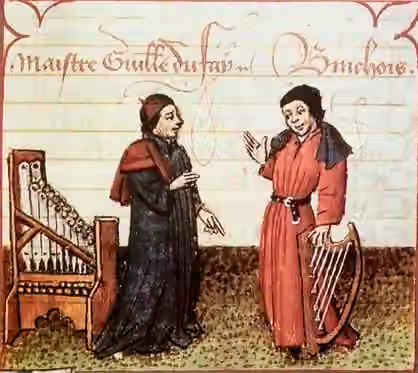
Nama dan identitas
Franco-Flemish School · Burgundian School · Dutch School · Franco-Netherlandish School · Netherlandish School · Low Countries School · Flemish School · Northern School
Adaptasi sumber terbuka. Uraian diterjemahkan otomatis menggunakan OPUS-MT en-id (lokal); perbaikan karakter dan repetisi; teks asal dapat diperiksa di setiap bagian. Identitas, lisensi, dan kelengkapan diperiksa secara otomatis. Belum ada tinjauan komunitas atau ahli yang tercatat.
Identitas dan konteks budaya#
Sebutan Sekolah Franco-Flemish, juga disebut Sekolah Netherlandish, Sekolah Burgundian, Sekolah Negeri Rendah, Flemish School, Dutch School, atau Sekolah Utara, mengacu pada gaya komposisi musik vokal polifonik yang berasal dari Prancis dan dari Burgundian Belanda pada abad ke-15 dan 16 maupun para penggubahnya. Penyebaran teknik mereka, terutama setelah pengembangan revolusioner pencetakan, menghasilkan gaya internasional sejati pertama sejak penyatuan nyanyian Gregorian pada abad ke-9. Komposer Franco-Flemish terutama menulis musik suci, terutama massa, motet, dan himne.
Rujukan bagian ini · revisi 1358628609Baca teks sumber bahasa Inggris
The designation Franco-Flemish School, also called Netherlandish School, Burgundian School, Low Countries School, Flemish School, Dutch School, or Northern School, refers to the style of polyphonic vocal music composition originating from France and from the Burgundian Netherlands in the 15th and 16th centuries as well as to the composers who wrote it. The spread of their technique, especially after the revolutionary development of printing, produced the first true international style since the unification of Gregorian chant in the 9th century. Franco-Flemish composers mainly wrote sacred music, primarily masses, motets, and hymns.
Uraian sumber 2#
Beberapa generasi komposer Renaisans dari wilayah yang dikenal sebagai Low Countries (Perial dan Perancis ditetapkan dalam persatuan pribadi oleh House of Valois-Burgundy dalam periode 1384 sampai 1384 1482)—i.e. Sekarang Perancis Utara, Belgia dan Selatan Netherlands—are dikelompokkan di bawah "Franco-Flemish School", meskipun guru-studi-relationship antara mereka jarang ada. Kebanyakan musisi ini lahir di provinsi Burgundian Artois, Flanders, Brabant, Hainaut, atau Limburg yang berkembang pesat. Yang lain lahir di Prancis Utara dan Selatan, seperti Guillaume Faugues, Simone de Bonefont dan Antoine Brumel yang merupakan salah satu penggubah paling berpengaruh dari generasinya. Selama periode stabilitas politik dan ekonomi, pengadilan Dukes Burgundian merupakan pusat kegiatan budaya di Eropa.
Komponis Franco-Flemish memiliki asal usul mereka di sekolah paduan suara gereja gereja gereja-gereja Saint-Quentin, Arras, Valenciennes, Doui, Bourges, Liège, Tournai, Cambrai, Mons, Antwerpen, Bruges, dan Ghent, meskipun mereka terkenal bekerja di tempat lain. Banyak musisi mendirikan diri di pengadilan Perancis atau pindah ke pengadilan Eropa di Italia di mana mereka disebut "I fimminghi" atau Oltremontani ("yang berasal dari pegunungan Alpen) dan Spain—notably di kapel Flemish (capilla flamenca) dari Habsburgs, atau ke kota-kota di Jerman, dan bagian lain dari Europe—Poland, negeri Ceko, Austria, Hongaria, Inggris, Swedia, Denmark, Saxony—carrying gaya mereka dengan mereka. Pusat yang tepat bergeser selama waktu ini, dan pada akhir abad ke-16 titik fokus dunia musik Barat telah pindah dari Negeri Rendah ke Italia.
Rujukan bagian ini · revisi 1358628609Baca teks sumber bahasa Inggris
Several generations of Renaissance composers from the region loosely known as the Low Countries (Imperial and French fiefs ruled in personal union by the House of Valois-Burgundy in the period from 1384 to 1482)—i.e. present-day Northern France, Belgium and the Southern Netherlands—are grouped under "Franco-Flemish School", though a teacher-student-relationship between them rarely existed. Most of these musicians were born in the thriving Burgundian provinces of Artois, Flanders, Brabant, Hainaut, or Limburg. Others were born in Northern and Southern France, like Guillaume Faugues, Simone de Bonefont and Antoine Brumel who was one of the most influential composers of his generation. During periods of political and economic stability, the courts of the Burgundian dukes were a centre of cultural activity in Europe.
Franco-Flemish composers had their origins in ecclesiastical choir schools such as at the cathedrals and collegiate churches of Saint-Quentin, Arras, Valenciennes, Douai, Bourges, Liège, Tournai, Cambrai, Mons, Antwerp, Bruges, and Ghent, although they were famous for working elsewhere. Numerous musicians established themselves in French court or moved to the European courts in Italy where they were called "I fiamminghi" or Oltremontani ("those from over the Alps") and Spain—notably in the Flemish chapel (capilla flamenca) of the Habsburgs, or to towns in Germany, and other parts of Europe—Poland, the Czech lands, Austria, Hungary, England, Sweden, Denmark, Saxony—carrying their styles with them. The exact centres shifted during this time, and by the end of the sixteenth century the focal point of the Western musical world had moved from the Low Countries to Italy.
Perubahan dan perkembangan#
Berikut ini adalah lima kelompok, atau generasi, yang kadang-kadang dibedakan di sekolah Franco-Flemish/Netherlandish. Perkembangan gaya musik ini terus berlanjut, dan generasi-generasi ini hanya menyediakan referensi yang berguna.
Rujukan bagian ini · revisi 1358628609Baca teks sumber bahasa Inggris
Following are five groups, or generations, that are sometimes distinguished in the Franco-Flemish/Netherlandish school. Development of this musical style was continuous, and these generations only provide useful reference points.
Uraian sumber 4#
Didirikan antara 1450 dan 1520, motet ini biasanya ditulis untuk empat suara, dengan semua suara yang sama. Mereka sering menunjukkan tekstur tebal dan gelap, dengan jangkauan yang lebih rendah. Komposer paling terkenal dari gaya ini antara lain Ockeghem dan Josquin, yang de profunis klamavi te, terdiri antara 1500 dan 1521, memberikan contoh yang bagus.
Rujukan bagian ini · revisi 1358628609Baca teks sumber bahasa Inggris
Composed between 1450 and 1520, these motets were typically written for four voices, with all voices being equal. They often exhibit thick, dark textures, with an extended low range. The most notable composers of this style include Ockeghem and Josquin, whose De profundis clamavi ad te, composed between 1500 and 1521, provides a good example.
Sumber dan cakupan
Kontributor Wikipedia bahasa Inggris · revisi artikel 2026 · diakses 2026-10-15.
Artikel tentang entitas budaya dalam konteks dokumentasinya; tidak mewakili semua variasi, pelaku, atau semua masa. Bagian uraian dipilih, penanda format dibersihkan, dan diterjemahkan otomatis.
Kontributor Wikipedia · CC BY-SA 4.0 · Riwayat dan kredit penulis · pemilihan bagian, penyuntingan bahasa, dan pembersihan penanda format serta terjemahan otomatis merupakan perubahan dari sumber.
Q185858 — identitas dan asosiasi Wikidata · Kontributor Wikidata · CC0 · revisi 2515848494. Klasifikasi P31 dan asosiasi negara P17; bukan batas budaya, kepemilikan, atau keyakinan semua pelaku. Penjelas tambahan dan rujukan dapat diperiksa pada sumber.
Informasi rilis dan ekspor metadata · Ketentuan penggunaan ulang
Pemeriksaan otomatis identitas, lisensi, sumber revisi, dan kelengkapan; bukan tinjauan ahli. Belum ada tinjauan komunitas atau ahli yang tercatat untuk profil ini. Uraian ini belum mencakup seluruh variasi yang mungkin ada.
Baca metode penyusunan